

Holbein and Lotto rugs: why Turkish carpets carry painters' names
History and origins · Published · 4 min read
By Mark Megerian
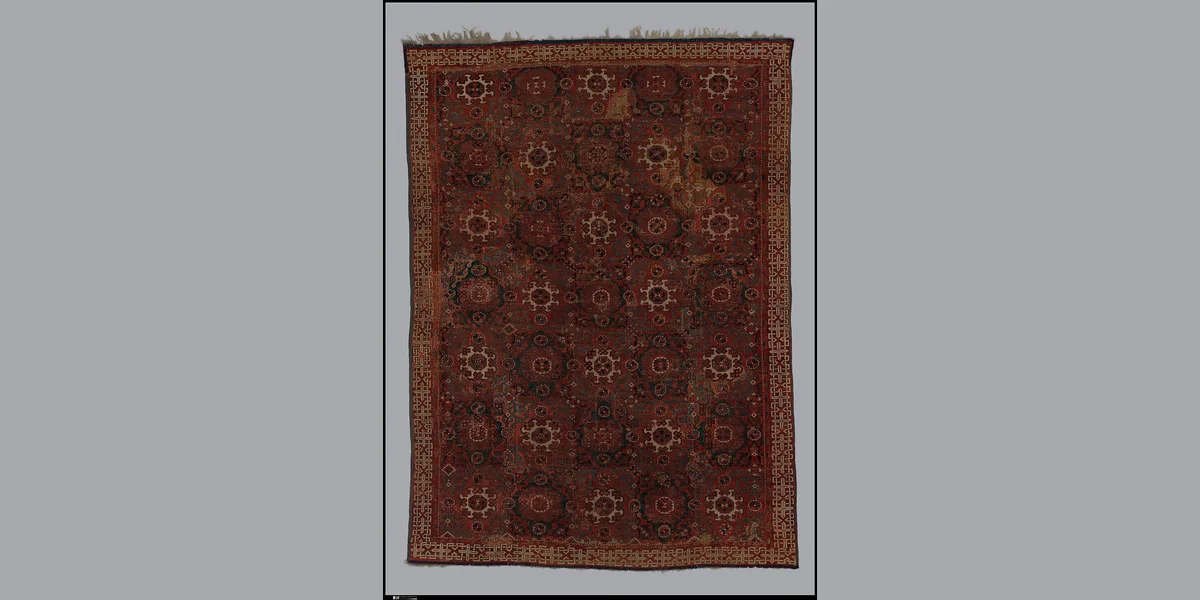
A museum label that calls a carpet a Holbein or a Lotto can sound as though it names the person who designed it. These labels instead connect Anatolian weaving with the European painters who depicted such carpets. Understanding that naming convention makes it easier to read a collection label without confusing a design group with a maker, a date, or a place of manufacture.
The names came from paintings
The Metropolitan Museum of Art explains that European paintings are an important source for studying early carpets. Names including Holbein, Lotto, Memling, and Ghirlandaio became labels for groups of carpets woven in Ottoman Turkey because the painters represented them in their work.
That is a history of how carpets were described and studied. The painters' names should not obscure the weavers and weaving traditions responsible for the textiles. When reading a label, keep its design name separate from the museum's attribution of origin and date.
A Holbein carpet at The Met
The Met's Holbein carpet, object 2009.458.1, is catalogued as Turkish and dated to the fifteenth or sixteenth century. Its pattern combines repeated small medallions with diamond-shaped interlacing. A broad, interlaced border surrounds the field. The museum connects the name with a Holbein portrait showing a similar textile over a table.
This is the carpet shown in this article's lead image. The photograph is supplied as public domain by The Metropolitan Museum of Art. Credit: Gift from the Collection of Hillary Black Dumas and Dr. D. Gilbert Dumas, 2009. It is a museum object, not a rug represented as belonging to Megerian Conservators.
Holbein describes more than one arrangement
In The Ambassadors, Holbein painted a carpet draped over the upper shelf between the two sitters. The National Gallery identifies its pattern as a large Holbein design, also called Type III: prominent octagons sit within large rectangular compartments.
Compare that arrangement with the smaller repeating units in The Met's example. The shared name does not mean the patterns are identical. The National Gallery also cautions that Holbein may have adjusted a carpet's apparent size for his composition. A painted textile is evidence to interpret, rather than a measured technical drawing.
What to look for in a Lotto carpet
The Met's sixteenth-century Lotto carpet, object 08.167.1, has a yellow pattern of angular, stylized plant forms across a red field. The museum explains that the name refers to a Lorenzo Lotto altarpiece depicting a comparable carpet. Its record attributes the textile to Turkey.
The border on this example has an interlaced design thought to derive from an angular form of Arabic writing known as kufic. That is a qualified account of the design's development, not a claim that every border is a readable inscription. Look at the field and border together when comparing examples.
Why a valuable rug might appear on a table
Carpets in these paintings are often elevated above the floor. The Met describes their role in portraits as signs of education, sophistication, and social standing. The National Gallery notes that related carpets served as table coverings and were also placed on floors for ceremonial occasions.
A painted table covering therefore does not establish that the textile was made only for tables. Its position is part of the painting's setting and message. Notice what rests on the carpet, how much of its border is visible, and which details the artist emphasizes.
Use the name as a starting point
If a rug in your home resembles one of these examples, record the resemblance as a question. A pattern name alone cannot establish that your rug is an early Anatolian original. Keep any purchase paperwork, previous descriptions, and treatment records with photographs.
For a practical first step, distinguish pattern from construction. If you are considering treatment or display, our appraisal and condition-report services and conservation page explain the available help. Do not pull threads or disturb an old repair to investigate a design.
Common questions
- Did Holbein and Lotto make the rugs named after them?
- The names refer to European painters who depicted comparable carpets. They are conventional labels for carpet groups, not signatures identifying the weavers.
- Are all Holbein rugs the same pattern?
- No. The name covers more than one arrangement. The small repeating motifs in the Met example differ from the larger compartments described in the National Gallery's account of The Ambassadors.
- Does a familiar pattern prove that a rug is antique?
- No. A visual resemblance is a useful starting question, but it does not by itself establish a rug's age, origin, authenticity, or value.
Sources and further reading
- Islamic Carpets in European Paintings, The Metropolitan Museum of Art
- 'Holbein' Carpet, object 2009.458.1, The Metropolitan Museum of Art
- The Ambassadors, collection catalogue, The National Gallery, London
- 'Lotto' Carpet, object 08.167.1, The Metropolitan Museum of Art